
25G Ethernet vs 40G Ethernet: Which to Choose?

درباره سایت
آخرین مطالب
- What is EVPN switch?
- Copper Cable vs Fibre Optic Cable Price, Is the Copper Really Cheaper?
- Network automation with FS N-series data center switches
- Shielded vs Unshielded Ethernet Cable: Which Should You Use?
- White Box Switch vs Brite Box Switch: Which to Choose?
- Which Ethernet Cable type should you use?
- Open Source vs Proprietary Software: Which Is Better?
- Web-scale vs Hyperconverged Infrastructure: What Is the Difference?
- Is MLAG an Alternative to Stackable Switches?
- 25G Ethernet vs 40G Ethernet: Which to Choose?
امکانات وب
EVPN introduces a new model for Ethernet services delivery. It provides a scalable, interoperable end-to-end control-plane solution for VXLAN tuels through using BGP, which means it offers an easier solution for layer 2 virtualization over a layer 3 routed infrastructure. EVPN is regarded as the next generation all-in-one VPN technology. Then what is EVPN? This articles focuses on EVPN, and then introduces EVPN switch.
What Is EVPN?
EVPN stands for Ethernet Virtual Private Network, providing Ethernet multipoint services over an IP or IP/MPLS backbone network. It’s an overlay solution for coecting dispersed sites like branch offices by a layer 2 virtual bridge, offering logical separation between customers using shared network resources. Like other VPN technologies such as IP VPN, VPLS, Ethernet VPN instances are configured on PE (provider edge) routers to maintain logical service separation. The PE routers usually coect to CE (customer edge) devices such as host, router or a Gigabit Ethernet switch. Then, PE routers can exchange message by MP-BGP (multiprotocol BGP) and the encapsulated traffic can be forwarded between PE routers. Note that, because EVPN architecture has the same elements as other VPN technologies, EVPN can be seamlessly introduced and integrated into the existing service environment. The following is a typical EVPN application. Data center 1 traffic is transmitted from MES1 to MES2 through the services provider’s network, and then the traffic goes to data center 2. DCS1, DCS2, DCS3 and DCS4 are switches here.

Figure 1: Typical EVPN diagram.
What Is EVPN Benefit?
Deploying EVPN brings many advantages.
- Fast convergence. When a link/node fails, EVPN can offer fast convergence by withdrawing a single route associated with each failed Ethernet segment, regardless of how many MAC/IP addresses are behind (for example, there may be 10K or more MACs). As a result, the remote PE devices will switch to other PEs in the redundancy group, which reduces traffic restoration time.
- Support multitenancy. EVPN uses the mature BGP VPN technology to separate tenants within a data center. Each tenant can be mapped to a unique VFR (virtual routing and forwarding), providing layer 3 isolation of their network traffic.
- Efficient traffic flows. EVPN reduces broadcast traffic in the data center by allowing the local leaf switch to respond to the host’s ARP (Address Resolution Protocol) requests, rather than forwarding these requests throughout the data center and creating expensive broadcasts, making the traffic flows more efficient.
In addition, EVPN can reduce unknown-unicast flooding due to control-plane MAC learning.
FS.COM EVPN Switch Is Coming
EVPN switch is a network switch with EVPN function. FS.COM has published N-series switch with Cumulus Linux OS which allows users to deploy EVPN. These switches are Top-of-Rack, Leaf switches or Spine switches in a compact 1U form factor. And this family provides multiple speed options, including 10Gb Ethernet switch, 25Gb Ethernet switch, 40Gb and 100Gb network switch. With low latency and power efficiency in a PHY-less design, N-series switches can provide stable, reliable and secure Layer 2/Layer 3 switching services. Besides, pre-loaded with Cumulus Linux OS, they support advanced features like MLAG, VXLAN, SFLOW, BGP, OSFP, EVPN etc. Thus, N-series switches are quite suitable for data centers and high-end industrial areas.
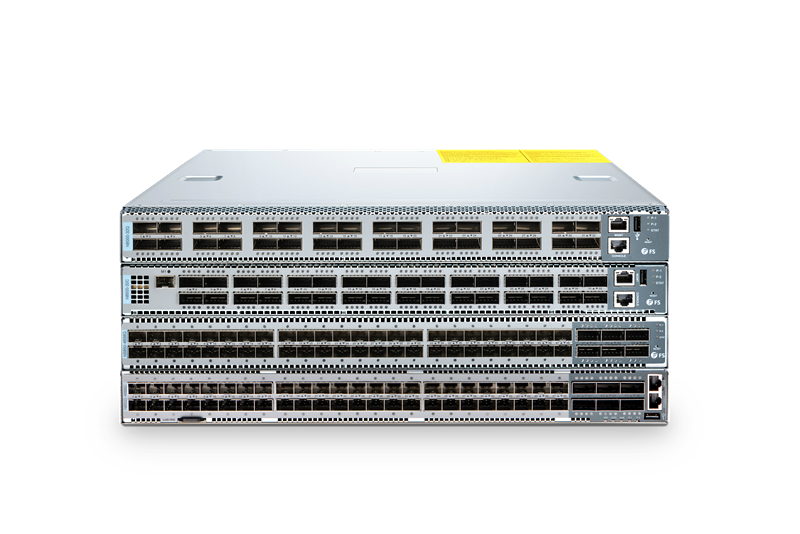
Figure 2: FS.COM N-series switches.
And, more remarkable, N-series switches can deploy EVPN. Cumulus’s unique VXLAN EVPN solution provides unmatched interoperability and efficiency. Cumulus EVPN eliminates the complexity of layer 2 coectivity and frees customers from relying on proprietary controllers. With these FS EVPN switches, customers can quickly and easily support new applications, storage systems, multi-tenancy requirements and business growth using the same infrastructure. In addition, Cumulus EVPN can discover VXLAN tuels automatically and exchange message among VXLAN nodes. Customers just need a few lines of code to create a single configuration which is available for all devices and routes. This can greatly reduce CapEx and OpEx.
Conclusion
From the above, I believe all of you have a good understanding of what is EVPN and what is EVPN benefit. FS.COM N-series EVPN switches are the best choices for data centers, since they can bring customers an open, high-performance and scalable solution for their networks and avoid vendor lock-in. If you’re interested in taking a more detailed look at the EVPN switch, please visit FS.COM, a reliable networking solution provider which also offers products like fiber transceivers, fiber cables, WDM & optical access solutions.
برچسب:
نویسنده: الینا صالحی